From Presence to Performance: Radio in the Connected Car Dashboard
For decades, radio has dominated the car. It has been the default companion of drivers – constant, trusted always… just there. For you.
But while radio has always been present in the dashboard, it has rarely been understood there. People can’t do without it, but they also don’t really notice it. That may finally be changing.
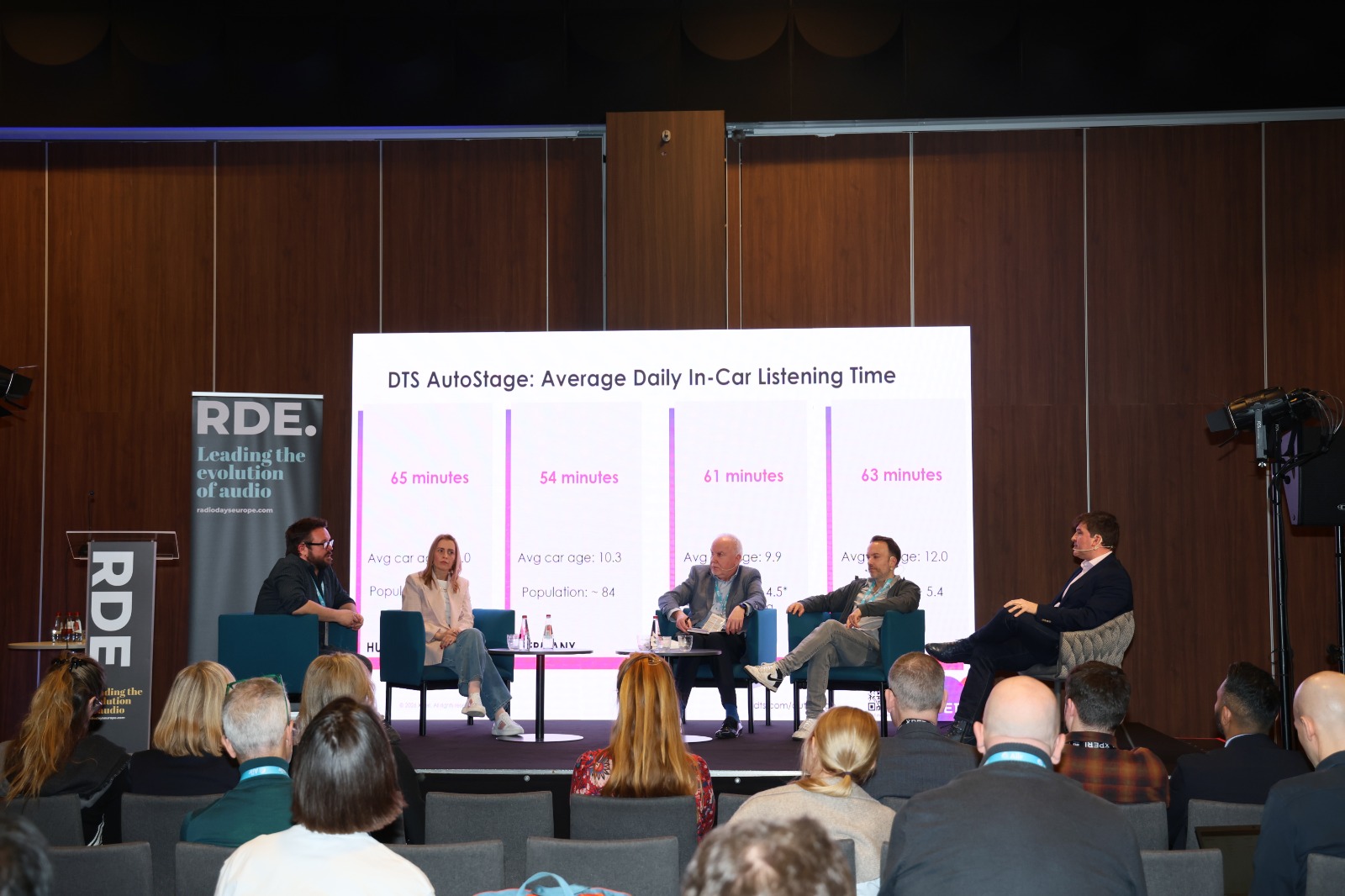
At Radiodays Europe in Riga, the session “Radio in the Connected Car Dashboard: Shortening the Feedback Loop” , Slager FM’s Tamara Orbán-Mikus, Christian Schalt from RTL Radio Deutschland, Benoit Bricq, Audio Project Manager, RTBF, FáilteDAB’s Neil O’Brien and George Cernat from Xperi explored what happens when radio becomes “measurable” inside the car. The result is not just more data – but a shift in how radio is made, evaluated, and improved. Because for the first time, broadcasters can actually see what is happening in one of their most important listening environments.
And that environment is massive.
In some markets, up to 50% of radio listening happens in the car. Data presented during the session reinforced this significance: in Ireland, 50% of audio consumption occurs in-car, while connected dashboard analytics showed average daily listening times ranging from roughly 54 to 65 minutes. Radio is not just present in the car – it’s a part of it.
What has been missing, however, is visibility.
Traditionally, radio has relied on delayed audience measurement – often based on recall, averages, and long reporting cycles. Connected car platforms such as DTS AutoStage are beginning to close that gap by combining broadcast radio with IP-delivered metadata and real-time analytics.
This creates something radio has never truly had before: an immediate feedback loop.
Broadcasters can now access detailed insights such as: geographic listening heatmaps, daily and hourly listening patterns, and real usage data from FM and DAB in-car consumption. Instead of waiting months, they can evaluate performance within hours.
And that changes everything.
Speakers highlighted how this data is already influencing programming decisions, music rotations, and even commercial strategies. In some cases, it challenges long-standing assumptions – revealing, for example, that peak listening times or audience behaviour in cars may differ significantly from traditional ratings.
It also introduces a new level of precision. Listening is no longer just measured – it is mapped, tracked, and understood in context. External factors, such as travel patterns or even public transport disruptions, become visible through shifts in real-time listening data.
At the same time, the session made it clear that this evolution is not just about analytics – it is about survival.
As in-car environments become increasingly complex with multiple platforms, apps, and operating systems competing for attention, radio’s position is no longer guaranteed. The dashboard is becoming a contested space.
Yet radio still holds one key advantage: presence.
Unlike many digital competitors, radio remains a native, built-in feature of the car experience. And with connected dashboards enhancing that presence through visuals, metadata, and interactivity, radio has the opportunity not just to remain relevant – but to become smarter.
Because the future of radio in the car is not just about it being there. It is about understanding what happens once it is.