The Big Topics in Commercial Radio: What’s Happening in Europe Right Now
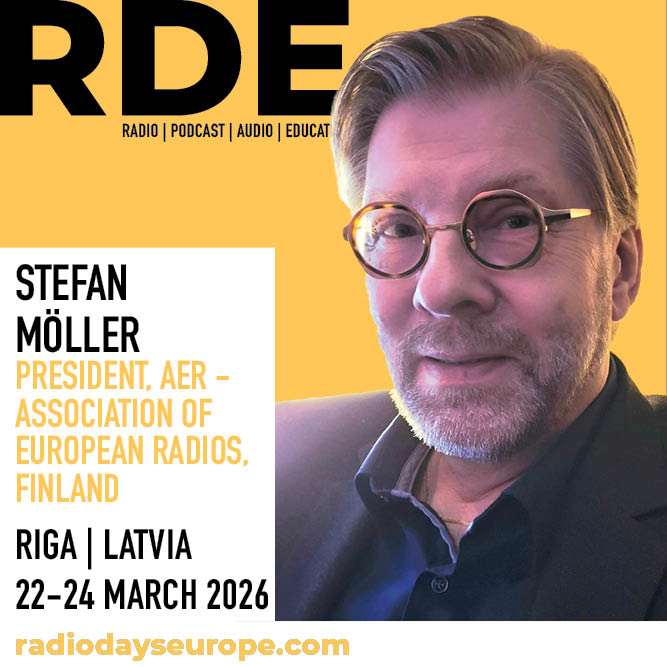
Stefan Möller is the President of AER — the trade association representing thousands of commercial radio stations across Europe. He also serves as Managing Director of the commercial radio trade body RadioMedia in Finland, and chairs the board of Radioplayer Finland.
His background is a mix of creative and executive experience: from early days as a musician (drummer) to roles as engineer, producer, marketing-director, station founder and radio director. That blend of artistic and managerial insight gives him a far-reaching perspective on radio’s past, present and future.
Commercial radio in Europe is undergoing the most dramatic transformation in its history. At the centre of the conversation is Stefan Möller, President of the Association of European Radios (AER), the organisation representing more than 5,500 commercial radio stations across the European Union, as well as the UK and Switzerland. Möller’s view is informed by decades of hands-on experience in the industry, from his early career as a presenter and producer to executive roles shaping national radio policy. Today, he leads AER’s mission to ensure that radio has a strong and sustainable future in a rapidly changing audio world.
For Möller, the defining story of commercial radio today is the shift from traditional broadcast to a broader digital environment. Radio is no longer tied to a single platform: audiences listen on FM, DAB+, smartphones, connected cars and smart speakers. This evolution creates new opportunities, allowing stations to combine live broadcast with digital innovation. At the same time, it raises serious risks. As listening moves onto digital devices controlled by global tech companies, commercial radio could be pushed to the margins unless policy frameworks protect its visibility and accessibility. AER argues that radio must remain free at the point of use and easy to discover — whether in the car, on a phone or on a smart speaker.
One of the biggest flashpoints in this transition is the connected car. For decades, the car dashboard has been radio’s most reliable home. Today, however, infotainment systems are increasingly shaped by manufacturers and digital platforms. At summits and industry events across Europe, AER and broadcasters have called on carmakers to guarantee the prominence of broadcast and IP radio in the dashboard experience. Their message is clear: radio supports trusted information, culture and music, and its place in the car must not be displaced by commercial partnerships or closed digital ecosystems.
Beyond distribution, commercial radio faces a new level of competition. The audio landscape now includes global streaming platforms, podcast networks and tech giants whose business models are often built without the regulatory and public-value obligations that apply to licensed broadcasters. While radio is governed by rules intended to protect pluralism and editorial independence, digital platforms can operate with minimal oversight. AER argues that this creates an uneven playing field and that the future of radio depends on fair competition, particularly around user interfaces that determine what listeners see first.
At the heart of AER’s advocacy is the belief that radio plays a vital cultural role in Europe. It provides local news, supports music scenes, and brings communities together during moments of crisis and celebration. As digital media becomes more fragmented, Möller emphasises the importance of maintaining radio’s editorial independence and its contribution to cultural diversity. For AER, innovation in digital formats must go hand in hand with the values that have defined radio for decades: trust, accessibility and a human connection with audiences.
Commercial radio is also redefining what it means to be a “radio” business. The rise of on-demand audio and streaming has forced stations to rethink their role in the broader audio ecosystem. Instead of focusing solely on mass-market reach, new strategies prioritise engaging specific communities, delivering personalised content, and using data to improve listener experience and advertising models. At events like Radiodays Europe, industry leaders have highlighted that radio’s strength lies in live storytelling, companionship and local relevance — qualities that stand out in an era of algorithmic playlists.
The stakes are significant. If commercial radio loses access to distribution channels, thousands of stations could face financial pressure, reducing local journalism, cultural programming and diversity. Ensuring radio’s presence in cars, smartphones and smart speakers is therefore not only a commercial necessity but also a democratic one. AER is working with European policymakers on legislation like the European Media Freedom Act to guarantee that licensed radio remains easy to find and free to access.
Despite the challenges, Möller views this era as an opportunity. Digital formats allow commercial radio to innovate, reaching younger audiences with flexible content strategies while maintaining its public value. The industry has the chance to blend the strengths of live radio — trust, personality, and immediacy — with the scale and accessibility of digital audio. Under Stefan Möller’s leadership, AER is helping shape a future in which commercial radio remains a cornerstone of Europe’s audio culture, even as the medium reinvents itself for a new generation of listeners.
Why You Should Join the Commercial Radio Discussions at Radiodays Europe Riga 2026
Radiodays Europe 2026 in Riga will be the most important moment of the year for anyone who cares about the future of commercial radio. The questions shaping the industry are no longer theoretical — they are live, urgent, and unfolding in real time. How will radio secure its place in connected cars? What rules will govern digital platforms that now sit between broadcasters and their audiences? How can radio redefine its business models without losing its cultural soul? And what role will trusted, local audio play in a world of global content?
These conversations are happening now — and in Riga, you will hear directly from the people shaping them. Stefan Möller, AER, leading broadcasters, policymakers, technologists and innovators will be on stage exploring the decisions that could define radio for the next decade. Whether you are a station executive, producer, advertiser, journalist or part of the wider creative economy, the debates in Riga will influence your work, your audience, and your strategic future.
If you want to understand where commercial radio is heading — and contribute to the decisions that will determine its future — Radiodays Europe is where you need to be. Riga 2026 is not just a conference. It is where Europe’s audio future gets negotiated, challenged and invented.