Is radio really dying?
At Radiodays Europe in Riga, one statement cut through the usual industry optimism:
“Radio is dying.”
At least, that’s how Steve Jones chose to open his talk. But what followed was not a pessimistic outlook – it was a reframing. Radio itself is not disappearing. Audio has never been stronger. Podcasts, audiobooks, streaming, and even AI-generated content are expanding the audio ecosystem faster than ever before.
What is actually dying, Jones argued, is the delivery system.
For over a century, radio has relied on a simple model: transmit from a tower, receive in a car or kitchen. That system worked so well it became invisible — and, perhaps, taken for granted. But that era is ending.
The “Milk Problem” of Radio
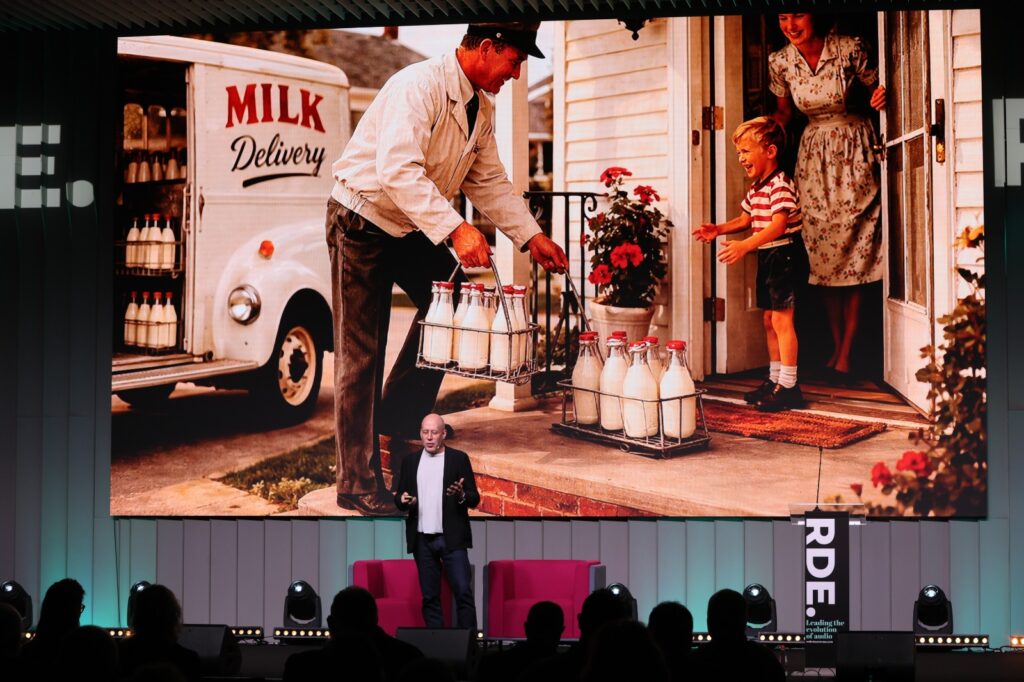
To explain this shift, Jones introduced what he called the “milk dilemma.”
People are not drinking less milk – they are just consuming it differently. Oat milk, almond milk, and other alternatives have replaced traditional delivery models. The product remains, but the system around it evolves.
The same applies to radio.
Content is richer than ever, but the way it reaches audiences is fundamentally changing. Just like banking moved from branches to apps, and film from cinemas to streaming platforms, radio is moving from hardware to software.
The Dashboard Is No Longer Guaranteed
For decades, radio had one unbeatable advantage: it was built into the car. Turn the key, and it was there. Today, that certainty is gone.
The dashboard has become a competitive digital space, where radio sits alongside platforms like Spotify, YouTube, voice assistants, and countless apps. Radio is no longer the default – it is one option among many. Even more importantly – control has shifted. Radio is no longer part of the hardware. It is part of the software. And that means access can be changed, limited, or even removed by platforms and car manufacturers.
As Jones put it:
“With the flick of a switch, someone working in Detroit could take us off the dashboard.”
From Content Strategy to Distribution Strategy
This shift forces a new reality: distribution is no longer automatic – it is strategic.
Jones summarized this through a simple framework: DASH
- D – Distribution: Being broadcast is not enough. Radio must be embedded where users are.
- A – Aggregation: Platforms like TuneIn act as gateways that ensure visibility and scale.
- S – Software: Speed, interface, and usability now define success.
- H – Habits: Listener habits are fragile — once broken, they are hard to rebuild.
This marks a major mindset shift for the industry. Radio can no longer rely on habit or default placement. It must actively compete for attention.
Alone vs Together
Perhaps the most important idea from the session was the contrast between two possible futures.
In one, broadcasters act independently – building their own apps, controlling their own distribution, but risking invisibility in a fragmented ecosystem. In the other, they collaborate – using aggregators, platforms, and shared infrastructure to remain present and competitive.
Jones was clear about his position:
“…radio should be everywhere the listener is.”
This includes platforms it does not control.
The Future Might Even Sing Back
One of the more unexpected ideas discussed was the integration of new formats into the in-car experience – including karaoke. While it may sound unconventional, it reflects a broader shift: the car is no longer just a listening environment, but an interactive one. The future dashboard may combine live radio, streaming, personalization, and new forms of engagement – all within the same interface.
A Simple Truth
For years, radio didn’t need to think about distribution. Now, it has no choice.
Because the question is no longer whether people listen to audio. It is how they find it.